Code enforcement is more than a profession—it is a calling rooted in service, responsibility, and compassion. When done well, it is one of the purest demonstrations of how government touches the everyday lives of its residents. “Code Enforcement with Purpose” is not just a slogan; it is the reminder that every knock on a door, every inspection, and every conversation has the potential to strengthen a community or break its trust. The choice belongs to us.

At the heart of purpose-driven enforcement is the understanding that humanity comes first. Every officer and inspector who steps into this work must know why they serve: not to punish, but to guide; not to intimidate, but to educate; not to create barriers, but to remove them. Purpose is what transforms regulatory actions into acts of stewardship. It allows us to see the person behind the complaint, the story behind the violation, and the community behind the policy.
The Inner Work: Mental Health and Maslow’s Hierarchy
But purpose is not sustained by good intentions alone. It is grounded in the well-being of the men and women who wear the uniform or carry the badge of responsibility. Code enforcement can be emotionally taxing—officers absorb conflict, frustration, fear, and sometimes hostility from residents who are struggling in their own ways. That is why mental health cannot be an afterthought. It is an essential tool of the profession.
Maslow reminds us that human beings can serve at their best only when their own foundational needs are met. Code enforcement professionals need:
- Safety, not only in the physical sense but in the assurance that their leadership supports them, values them, and equips them.
- Belonging, through teamwork, shared mission, and departments that foster respect instead of isolation.
- Esteem, built on meaningful training, strong policies, and acknowledgment of the unique contribution they make to public service.
- And ultimately, Self-Actualization, reached when an officer knows they are working in alignment with their gifts, their integrity, and their purpose.
An inspector who is mentally healthy, properly supported, and emotionally grounded is more capable of serving with clarity and consistency. They communicate better. They listen more deeply. They resolve conflict with empathy. They enforce with integrity.
When officers are cared for, the community is cared for.
The Duty of Municipal Leaders
Purposeful code enforcement does not happen by accident—it must be built, protected, and prioritized by municipal leaders. Managers, directors, and elected officials carry the responsibility of shaping departments where officers can thrive.
Leaders must:
- Make code enforcement a visible priority, not an afterthought delegated to the margins of government.
- Provide ongoing, accredited training so officers are confident in both the law and their ability to apply it fairly.
- Invest in staffing, tools, and technology that elevate accuracy, safety, and efficiency.
- Create policies that empower inspectors, rather than restrict them through unclear directives or lack of support.
- Model the respect they expect officers to show the community.
A purpose-driven department is not measured only by how many violations are corrected, but by how many lives are touched with respect, patience, and fairness. When leaders set this tone, officers can serve without fear, residents can respond without defensiveness, and the community can grow without division.
A Closing Embrace
To the men and women doing this work every day—those who show up with courage, compassion, and consistency—I thank you. You walk into unknown situations, you manage conflict no one else sees, and you carry the responsibility of protecting neighborhoods while honoring the people who live in them. You are educators, mediators, problem-solvers, and peacekeepers.
I see you. I appreciate you. And I embrace you. Thank you for what you pour into your communities.
You are the heart of Code Enforcement with Purpose.
And because of you, our cities are safer, stronger, and more humane.
ABOUT THE AUTHOR
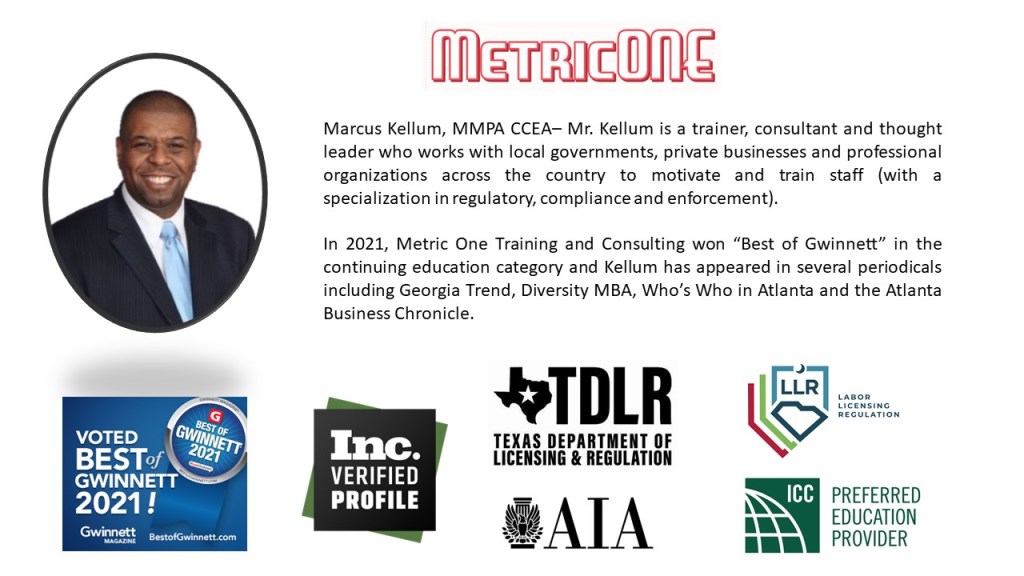
Marcus Kellum is a trainer, facilitator, and consultant who works with local governments, private businesses, and professional organizations nationwide to train and optimize their staff. An innovative and dynamic speaker, Marcus’ hands-on training style, engaging topics, and informative classes are nationally recognized. Marcus spent three decades in public service working with various cities and counties throughout the country and has held positions of compliance planner, code division manager, chief of enforcement, and department director. A registered civil mediator, certified code enforcement administrator, soil and erosion inspector, and property maintenance and housing inspector, he received a Leadership Effectiveness certificate from the University of Notre Dame’s Mendoza College of
Business, and he holds a Master of Management and Public Administration Degree, and a Bachelor of Science in Criminal Justice. His consulting firm, Metric One Training and Consulting won “Best of Gwinnett” in the continuing education category, and he has appeared in periodicals including Georgia Trend magazine, Diversity MBA magazine, Who’s Who in Atlanta, and the Atlanta Business Chronicle.
With over forty accredited classes, presented in over 20 states to thousands of officers and inspectors, Marcus’ presentation style makes learning enjoyable.










 marcuskellum.com